Former Canadian Supreme Court Chief Justice and bestselling novelist Beverley McLachlin has set precedents both in and out of the courtroom.
Beverley McLachlin, former Chief Justice of the Supreme Court of Canada and bestselling author, laughingly acknowledges that it is a big ask when she’s challenged to describe herself.
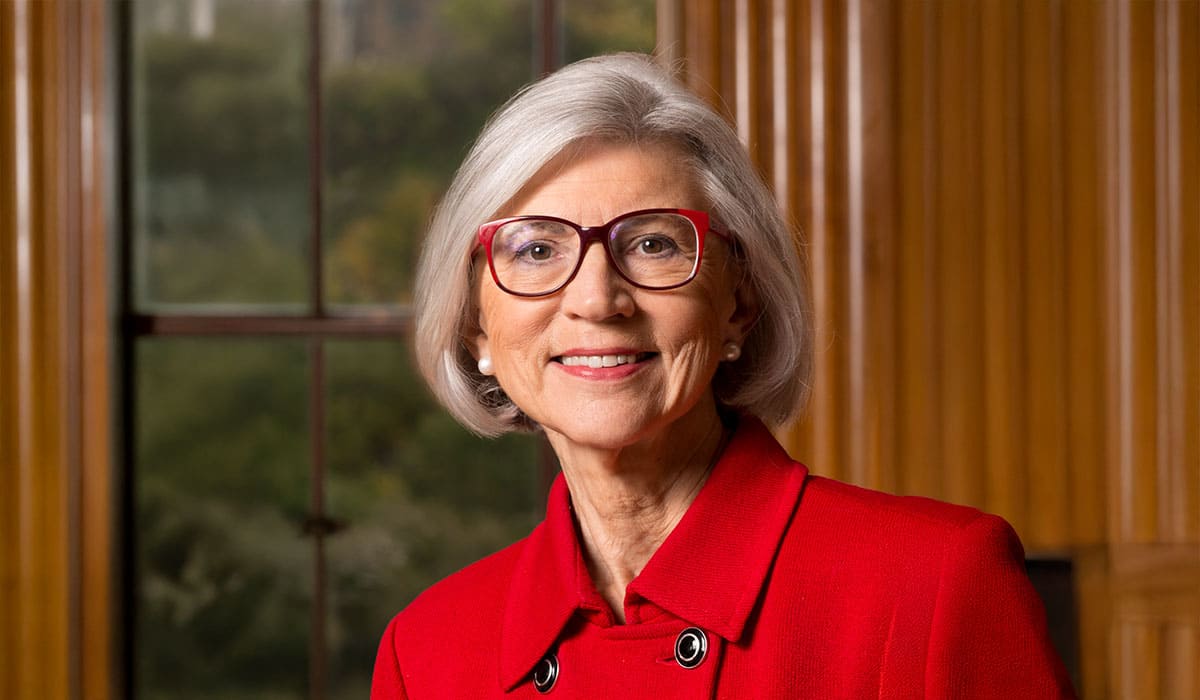
For our Zoom call, McLachlin sports a black sweater overlaid with a snazzy black- and-white checkered jacket and two silver necklaces, one adorned with an elegant drop pearl. Her crown of snowy-white hair and squared red glasses complete the portrait of a woman who is stylish, sophisticated and deliciously intriguing.
The first thing I notice is her delightful and approachable smile, one that must have given those on trial in her courtrooms a sense of quiet hope for redemption.
As she leans into the interview, her comportment is thoughtful and unhurried, and as she reflects on her upbringing in rural Alberta it is obvious that she is enjoying the memories, expressing her thanks here and there for my questions.
“I have a pretty normal life, with a great husband and son, and I have a strong work-life balance,” McLachlin says. “I love working with words and my imagination and I am always thinking about writing. I walk my dog a lot and I stay active. Pretty ordinary stuff, really.”
Which is hardly the case considering the accomplishments and firsts that McLachlin has achieved in her 81 years.
Indeed, the only “ordinary” thing about this former jurist is her own assessment — that she considers her extraordinary biography ordinary.
In her 2019 memoir, Truth Be Told: My Journey Through Life and the Law (Simon & Schuster Canada), McLachlin shares the details of growing up in a log house without electricity or running water in a rural area outside of Pincher Creek, Alberta, a town of two thousand souls built beside the narrow stream that flowed down from the Rocky Mountains.
McLachlin says that she was brought up with the values of hard work and community responsibility. “We were taught that nothing would be given to us on a silver platter, that we had to work for it. And while we lived miles away from our neighbours, we helped each other out whenever there was a need. The sense of community was strong, and everyone had a role to play within it. What the community thought of you was very important,” McLachlin says. “We learned to turn our hand to anything, and that is probably why I am willing to try most everything.”
She garnered a “don’t mess with Beverley” reputation when she was a young girl after riding her bike over the leg of a boy who had stuck it out in front of her, and McLachlin absorbed that distinction into her psyche, determined that if anyone tried to stop her, she would go around them and carry on with what she intended to do.
While there was little money for the extras in her small community, it was quite literary, according to McLachlin, an environment that nurtured her voracious and ongoing love for books.
“We had a lovely library which I read my way through,” McLachlin says. “The local women collected money for books, which provided me and the other kids with a window onto the world. It is where I learned to read and write, which were the core essentials and the ultimate basis for me getting into university and then the law.”
After being called to the Alberta Bar in 1969, McLachlin practiced law in both Alberta and British Columbia and taught law for seven years as an associate professor at the Faculty of Law at the University of British Columbia. Numerous appointments followed, including to the Vancouver County Court, the Supreme Court of British Columbia and the British Columbia Court of Appeal. McLachlin was Chief Justice of the Supreme Court of British Columbia when Brian Mulroney appointed her to the Supreme Court of Canada in 1989. In January of 2000, McLachlin was appointed Chief Justice of the Supreme Court of Canada, the first woman to hold this post. McLachlin is also the longest-serving jurist in that position.
Reminiscent of the Tim McGraw song, “Humble and Kind,” whose lyrics tell us to feel pride in our hard work while staying humble and kind, McLachlin thanks Canada in her memoir for allowing her to realize her dreams. “Only in this country could a country girl of no consequence have risen to the summit of the judiciary,” McLachlin writes.
Because she grew up without any expectations of becoming successful or famous, McLachlin says that at times she has felt like an imposter.
“I would start out with a lot of self-doubt and then I would manage to surprise myself,” she says. “It was a combination of brash courage and low expectations. When you do better than you expect of yourself, you feel good about it, and it encourages you forward. I never dreamed I would be a judge or a Chief Justice or a bestselling author. But I’ve always experienced these big surprises, which makes me very happy.”
While McLachlin is a powerful example in her own right, on her journey there have been women she has met and admired who have enriched her own life.
One woman in particular stands out. As a young girl, McLachlin had a crush on Queen Elizabeth II, and was obsessed with the photos and press coverage related to the young princess’s crowning. In fact, McLachlin kept a scrapbook with all the magazine and newspaper articles she could find about the Queen’s coronation. Decades later, McLachlin’s infatuation was gratified when she sat beside the Queen at an Ottawa gala and got to spend time chatting with her ideal.
“The Queen shared a lot with me about her personal life growing up. It was fascinating, and something you don’t usually get from royalty,” McLachlin says. “Having been a huge fan of hers growing up, I knew all the details about her dogs and horses, about her sister and what they did during the war. I knew enough that she could treat me like a confidant. It was quite a surprise and quite an amazing experience in my life.”
Ruth Bader Ginsburg, the first Jewish woman to serve on the United States Supreme Court and a fierce advocate for gender equality and women’s rights, was also a person who had an impact on McLachlin. “Ruth was very brave and plucky with a lovely sense of humour,” McLachlin says, recalling their meeting over lunch in the Gatineau Hills. “Ruth’s passion was the furtherance of women’s rights through jurisprudential developments such as voting, property and the right to control one’s body, advances which have experienced recent reverses in the United States,” she says.
In 2017, after serving on the bench for decades, McLachlin decided to retire nine months before the mandatory age of seventy-five. “I thought I was happy with the decision, but it was very hard for a while. I missed having people around me, my colleagues and my support staff, who used to manage my schedules and tasks for me. As such, my life skills were not well-honed,” McLachlin says with a wry laugh. “But retirement is a transitive verb. Life moves on and you find other interests. I am involved in some international arbitration processes and am also writing fiction, which is my biggest surprise, the fun of creating characters and situations. As a judge you don’t get much opportunity to be creative, so writing fiction is fun for me.”
“ONE OF THE GREAT PLEASURES IN LIFE IS GETTING TO MEET NEW PEOPLE AND FINDING OUT WHAT MAKES THEM TICK.
Indeed, McLachlin’s three legal thrillers, published by Simon & Schuster Canada, include Full Disclosure (2018), which was a national bestseller, and Denial (2021) and Proof (2024), both of which also achieved recognition. In 2020, Truth Be Told: My Journey Through Life and the Law won the Writers’ Trust Shaughnessy Cohen Prize for Political Writing and the Ottawa Book Award for Nonfiction.
Any additional challenges of retirement for McLachlin have been mitigated by the people she meets, especially in Vancouver, where she now lives.
“One of the great pleasures in life is getting to meet new people and finding out what makes them tick,” McLachlin says. “One day when I was on the bus, a young man came and sat beside me and thanked me for saving the Insite injection sites.”
Family is also of immense importance to McLachlin. In fact, her smile takes on a whole new glow when she talks about her son, Angus McLachlin.
“I told Angus that I didn’t feel like I was a very good parent,” McLachlin says. “And Angus said to me, ‘Even if you weren’t in the room, I knew you were there, that you had my back all the time.’ And that is what is important. If you as parent and child are solid together, it carries through to different experiences and into different phases of your life together, which is a beautiful thing.”
While McLachlin states that “judges can’t have agendas, but we can make things better for people,” there are particular experiences throughout her career as a jurist that she considers to have had a powerful impact. These include helping to delineate Indigenous rights, something she identifies as a privilege to have been a part of.
“It is critical to recognize the past wrongs that have been made and not bury them,” McLachlin says. “Women’s rights, being cognizant of the ordinary plight of human beings and how we can alleviate the suffering of others is key. I also worked very hard on the MAID (Medical Assistance in Dying) legislation, for which my decisions stand up well legally. People stop me on the street to talk about how important and uplifting the right to having help when their loved ones are dying has been. MAID has brought comfort to families and loved ones and has eased their suffering. I understand that there is still controversy around this, but I get a lot of gratification knowing that we have helped people.”
For McLachlin, living the dolce vita includes both immersing herself in nature and fulfilling her personal potential each day.
“I like to seek out places that give me a geographic release, where I can take walks in the woods and go canoeing — activities that allow me to rise above the mundane troubles of life. I loved riding horses when I was young, and I miss that sense of elation and freedom. However, at this stage of my life, I have been told that it is not a good idea,” McLachlin says, with a laugh that is charmingly contagious.
“I also believe that as we get older we need to appreciate the sense of preciousness in every day. We need to keep learning, keep being creative, keep being active and keep developing. It is never too late to learn new things.”
To that end, McLachlin is part of an in-person lecture series on democracy and the law, where she shares her thoughts on the resilience of Canada’s judicial system in the face of populism, mistrust, misinformation, and political polarization, as well as the role of courts in safeguarding democracy.
As we sign off (not with the bang of a judge’s gavel, which McLachlin laughingly reminds me does not happen in Canada), she shares that she is off to Antigua with her 96-year-old husband, Frank McArdle.
And the warmth of her beaming smile as McLachlin expresses her thanks for our chat could rival any of the sunny destinations she so robustly enjoys.