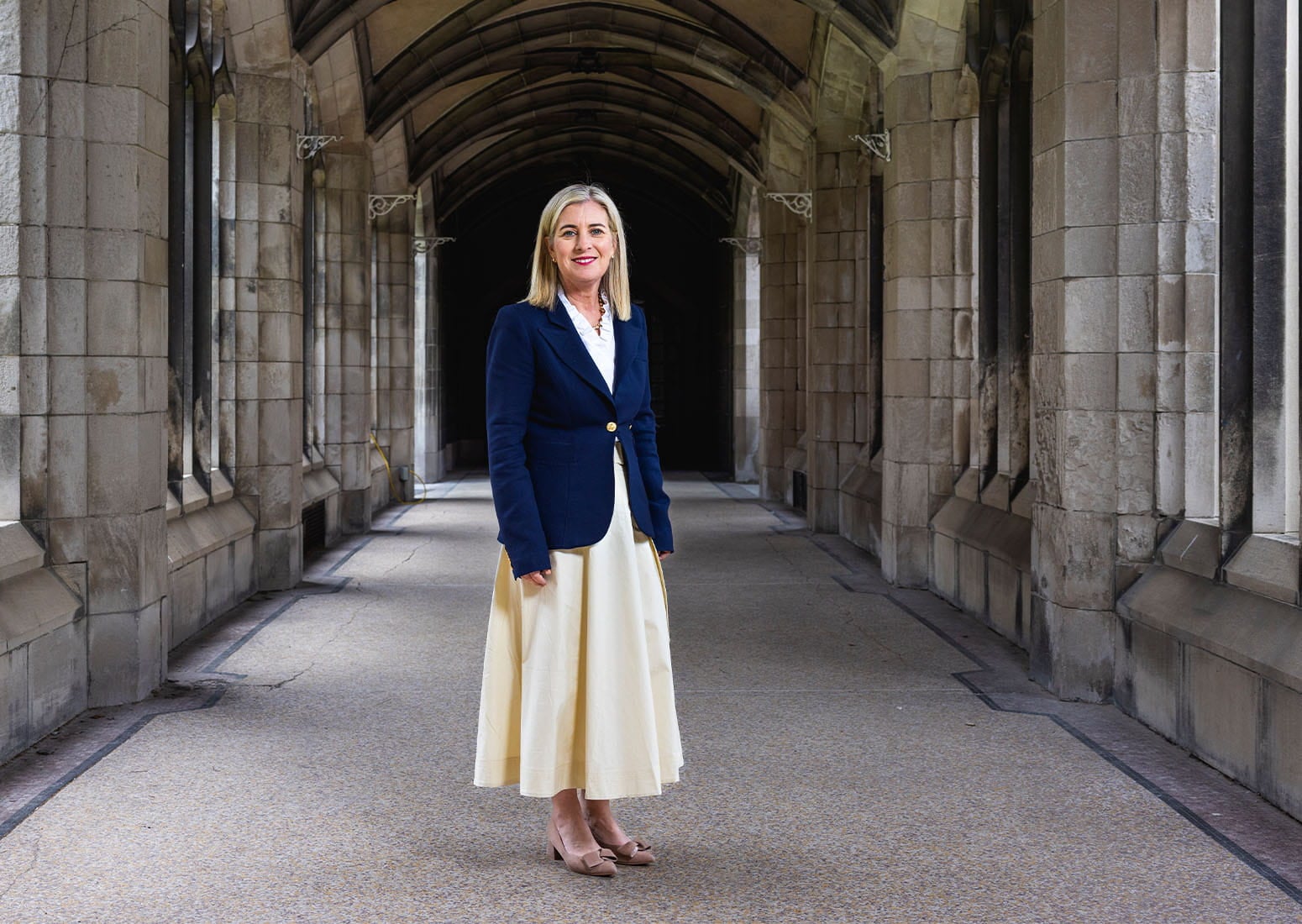
A generational shift has happened at the University of Toronto with the election of Melanie Woodin as its new president.
To get an appreciation of the considerable brain power of Melanie Woodin, a Canadian neuroscientist and academic administrator appointed as the University of Toronto’s 17th president in 2025 and the first woman to hold the position, you may want to start with the title of her university thesis: “The Role of Trophic Factors in Synapse Formation and Plasticity between Identified Lymnaea Neurons.”
Huh? Who even thinks that way, let alone has the mental acuity to do the research and writing required to support such a thesis? In a 40- year writing career, there are at least three words in that title I’ve never even typed before. Speaking of neurons, clearly, Ms. Woodin operates at another level than the rest most of us mere mortals.
Born in Montreal, Woodin has lived in many places around Canada, but for more than 20 years she has called Toronto home. “It was because of a combination of things; some really fiery science teachers in science class in high school, and my mother, who was passionate about the natural world,” says Woodin in a recent interview with Dolce Magazine. “We used to spend a lot of time outdoors as a family, camping, boating and exploring the province. Through that, my mother and my interest in science, I was interested in pursuing my undergraduate degree in the sciences and exploring what it means to be a scientist. Many of us might not know where you do that work, but one thing I did know was that the University of Toronto was a research powerhouse.”
Woodin graduated from U of T in 1995 with a Bachelor of Science in Biology and then a Master of Science in Zoology in 1997. In 2001, she completed her PhD in neuroscience from the University of Calgary, then completed her postdoctoral studies at the University of California, Berkeley. Woodin returned to the University of Toronto as a faculty member in 2004, and she established the Woodin Lab, which she continues to lead. Prior to her appointment as president, she served as Dean of the Faculty of Arts & Science. Being appointed president of the University of Toronto is one of those full-circle life moments for her.
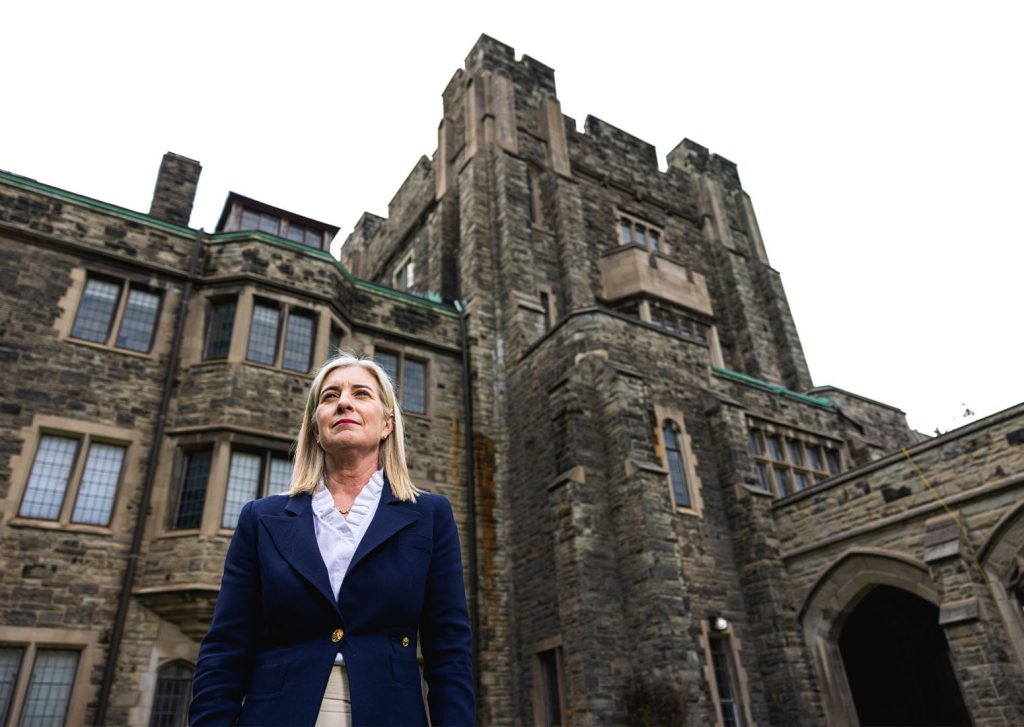
“I often think about my first biology lecture here. It was at Convocation Hall and my professor was explaining what biologists were, and how you became one,” Woodin recalls. “In fact, many biologists were professors, then they described the path to get there. There would be an undergrad degree, a master’s degree, a PhD degree, a post- doctoral fellowship, and then you became a professor. My friend and I were chuckling in the back, and I thought, ‘Who would do that? That sounds like way too much education.’ Little did I know it was going to be me.”
The University of Toronto consistently ranks among the top universities in the world and usually in the top three in Canada. It now has more than 100,000 students on its three campuses in Toronto, but more than just size, Woodin says it’s U of T’s three key value propositions that make the difference in attracting and retaining the top talent, and you can clearly hear the passion she has when speaking of her alma mater and workplace.
“‘Who Would Do That? That Sounds Like Way Too Much Education.’ Little Did I Know It Was Going To Be Me.”
“Access, excellence and scale,” says Woodin, explaining. “We are a top academic and research institution, one of the very best in the world. With 100,000 students, if you’re a good student you’re likely going to get in. We also have internship and co-op placements so students can get firsthand practical experiences. And we have a commitment, enshrined in our policies, allowing financial-access guarantees for permanent residents and Canadians, meaning no student is going to be turned away due to financial need. On average, we pour $400 million every year into student aid, so on average our students pay about $4,000 per year in tuition.”
Clearly, the pressure is even greater these days for educators to deliver — as many students are frustrated and anxious and may be graduating into a Canadian labour market where the unemployment rate for people ages 15 to 24 is 13.8 per cent, double the national average. The 2026 World Happiness Report ranks Canada 25th overall, but 71st for those under 25. It is more important than ever to engage with students, and Woodin may be the perfect person to do that to elevate U of T’s stature. She is about as far away from the images we might have of university presidents of yesteryear, of elderly white men recalled from faded photos, with their sober suits and superfluity of facial hair.
“It’s really important to be connected with the community here, so I’m always out meeting the students and learning from them about what’s happening in the classroom,” says Woodin in explaining a typical day. “I take a lot of photos with students because it happens nearly every day, and I invite students to do that. If students see me walking on campus, they should stop me and say hi as I love those conversations.”
It is clearly a new day at the University of Toronto, one of the world’s most venerable and innovative academic institutions, which will be starting its third century next year. And with Melanie Woodin’s passion for education, youth, vitality and engagement with students, the next generation is in very good hands.