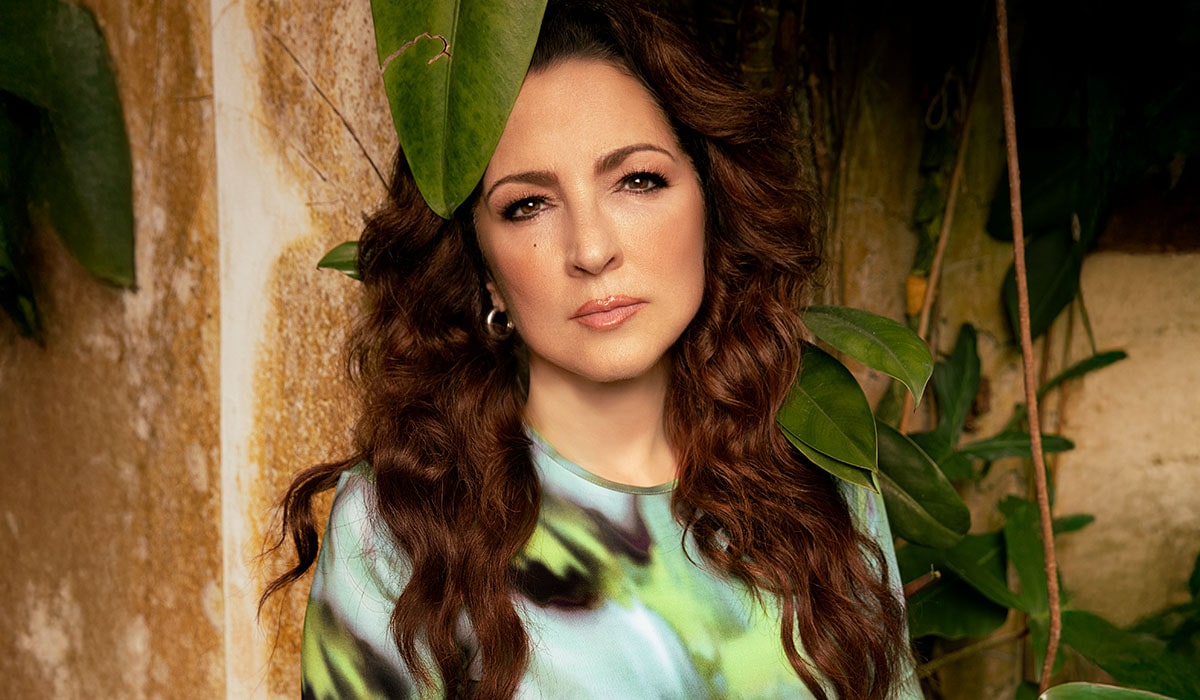
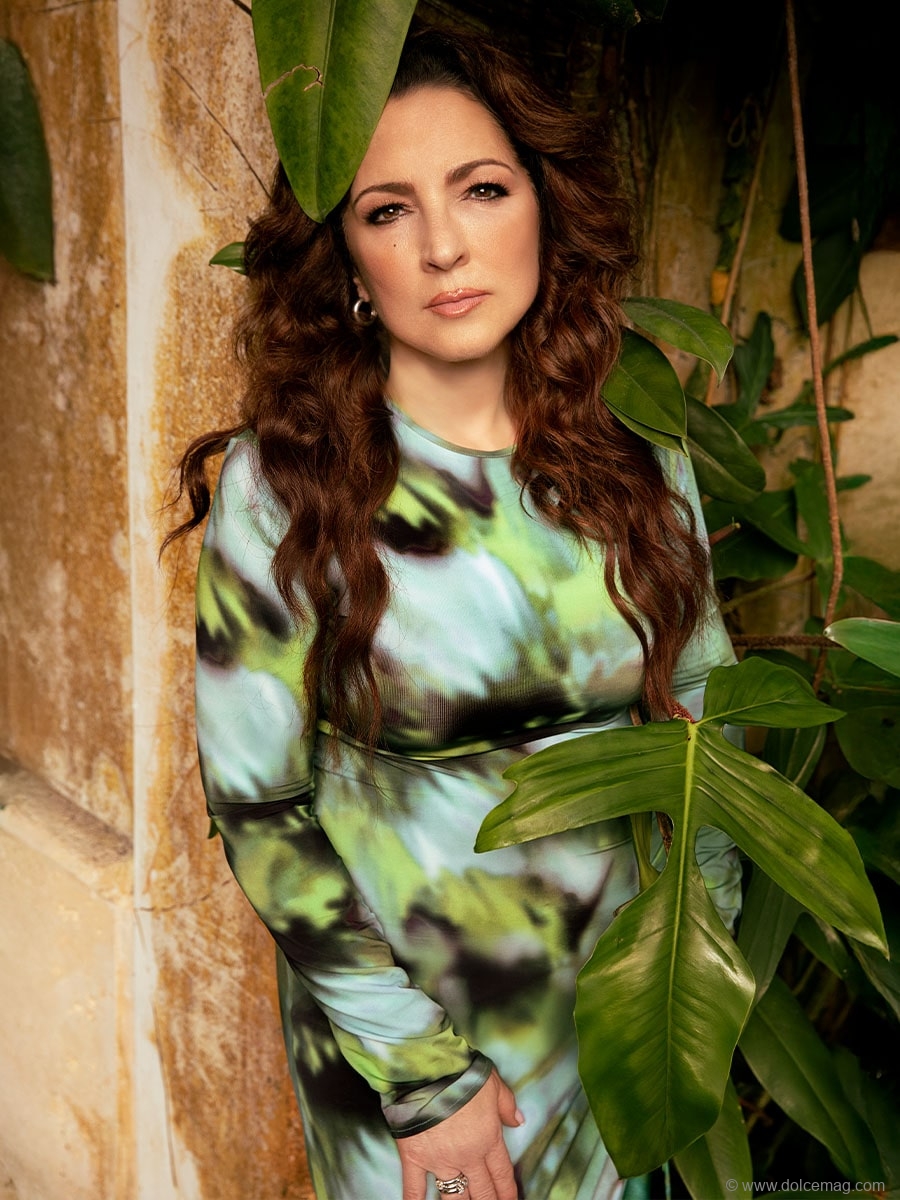
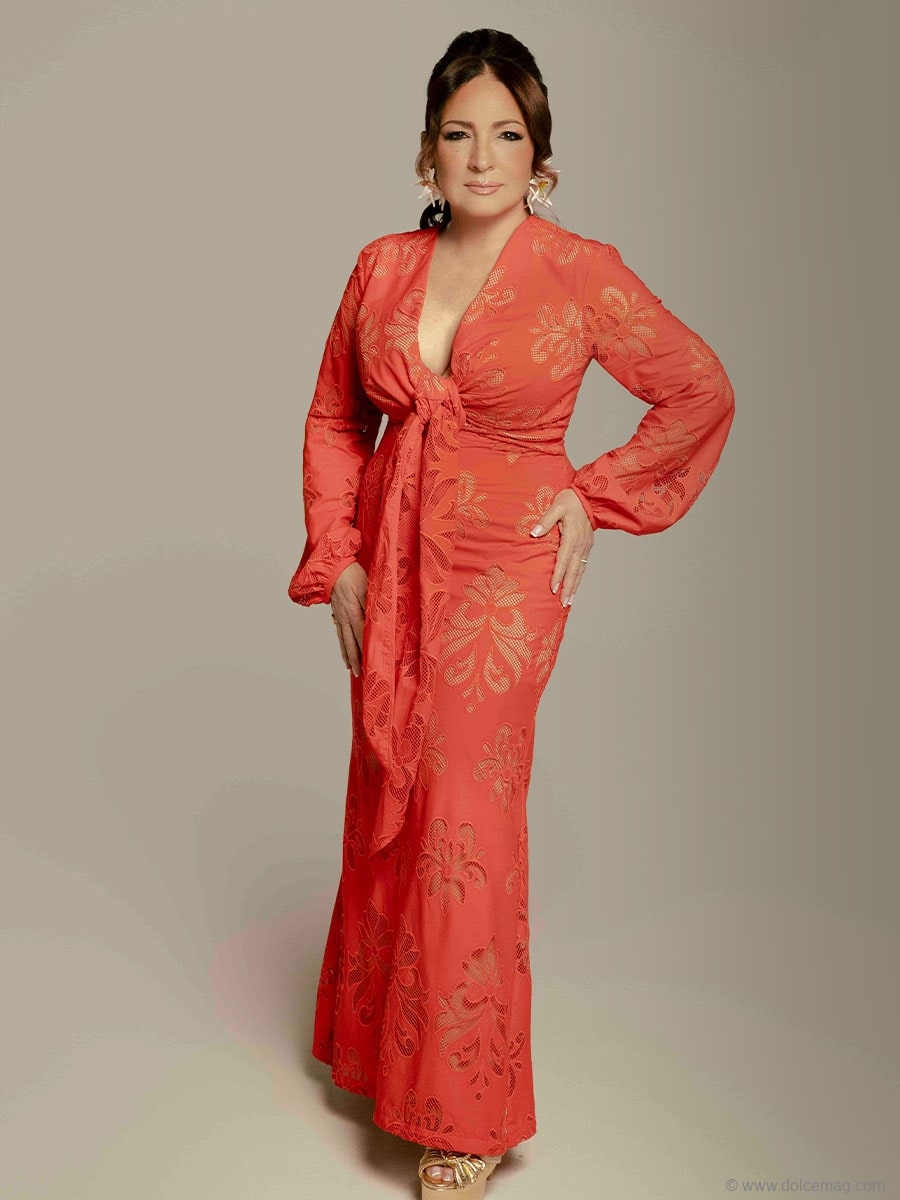
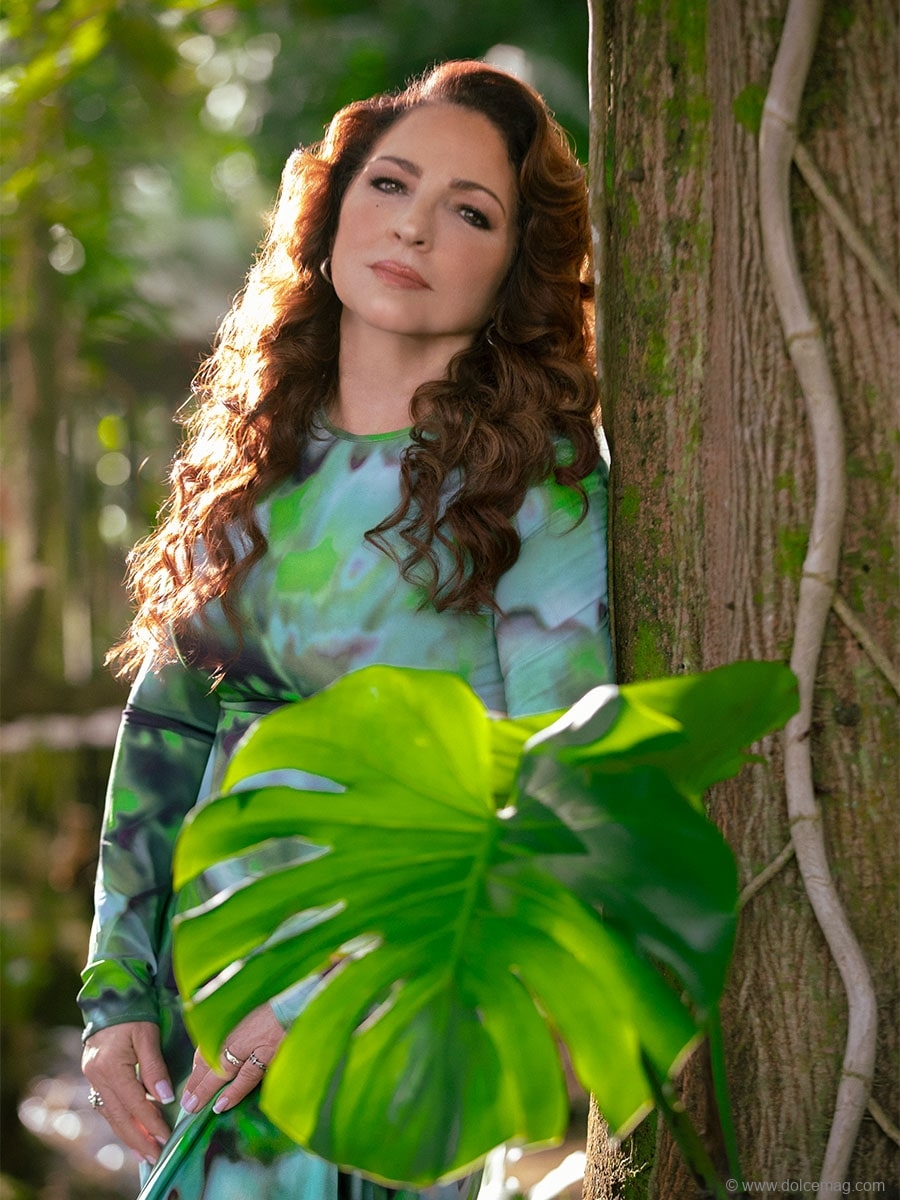

With her new album Raíces, Gloria Estefan explores her roots once again, combining authentic Cuban rhythms, Spanish lyrics and a modern sound. But family — Emilio, her husband of nearly 50 years, their kids and grandkids — always comes first.
These days, we take it for granted that J Balvin can dominate the charts, Jennifer Lopez can grab the headlines with her life on- and offstage and Bad Bunny can conquer audiences worldwide. But such wasn’t always the case. When Gloria Estefan started out in the mid-seventies as the singer for Miami Sound Machine, there were very few places a Latin musical artist could go. As a pioneer of the “Miami Sound,” she opened the doors for countless musical artists to walk through and sold more than 100 million records worldwide. Having success both in English and Spanish while staying true to her Cuban roots (there’s Cuban percussion in almost all of her songs), Gloria and her husband, Emilio Estefan — also her manager, songwriter and producer — have done it all, including a 2015 Broadway musical based on her life titled On Your Feet! In 2025, Gloria is releasing a new record, Raíces, that is entirely in Spanish and proudly showcases her Cuban influences.
In person Gloria is very warm and friendly, but you can also feel her determination and take- charge attitude. Her husband, Emilio, was with her as we spoke, and the two kept trading jokes and stories like a well-oiled comedy duo. She’s done it all but still wants more. Eventually, her rhythm is going to get you!
Q: Your family was musical on your father’s side. Was there a lot of music at home when you were growing up?
A: There was a lot of music, but it was actually from my mother’s side because [although] my father had two brothers who were musicians, my mom was like the triple threat of her school. She won a contest to be Shirley Temple’s double when she was a small child, and for that reason I think it stayed in her life even though she wasn’t able to do it as a business or as show business because her father didn’t allow her to go to Hollywood. She was the star of her school. The only way she could get a diaper on me was to sing to me and I would just melt, and she would play all her mom’s records and the records that she had. So music was around me the whole time.
Q: You arrived in the United States when you were little and grew up as a child of immigrants. What do you remember from growing up in Miami while your parents had to adjust to a new country?
A:I was a toddler — so I was, like, two and a half — but I was very precocious, and I completely knew what was going on around me. My dad came first. He took the ferry from Cuba to Key West to try to look for a job, and then as soon as he had one we stayed at his sister’s house. His sister had moved out, had left Cuba, and we were staying with her temporarily. My mom and I flew on a Pan Am — I still have the round-trip ticket — they were planning on going back. That was their thought: “We’re going to leave Cuba for a little while.” And my dad immediately got involved with the Bay of Pigs project, without my mom knowing. He joined the brigade because he had been a police officer in Cuba. He was a part of it because of all his connections — they were all friends, they were going to try to overthrow the government. Meanwhile, my mom and I came to Miami, and everywhere we would look to try to rent an apartment, they had signs that said “No children, no pets, no Cubans.” Everybody was so afraid of there being a massive influx. And it was still the Deep South, there was a lot of prejudice in many different ways. My mom found this one place that was brand new, two little apartment strips facing each other. She asked the landlord if she could fill them for him. So she brought all her friends and family, who were young women with small children, whose husbands had all become a part of the Bay of Pigs movement. We grew up kind of like in a little commune. I remember going with my mom from church to church, and rosary group to rosary group, praying for the men that were in jail. They became political prisoners in Cuba.
My mom was 29 years old, and she had lived a life in Cuba … she was like the princess of the family! And suddenly here she was with a small child in a new place. She had visited Miami on vacation with her dad when she was 15 years old, they would come and stay in hotels, and as a tourist it was one thing, but now, suddenly with nothing, as an immigrant, it was a completely different experience.
Q: Was there a particular singer who influenced your singing style, who was your singing idol or your inspiration?
A: My very first crush was this young Spanish singer — because when we came to Miami and my grandparents eventually made it out, my grandfather would save up and take me to movies — his name was Joselito and he had this angelic voice. He was six years old, I was four. And he made movies and sang from the time he was a little kid. So [my grandfather] would get me his record, and I knew all his songs. I would sing them — I would memorize them and sing them, even when I was a young child. And then, after that, my grandma slowly had been sending my mom her record collection stashed in a box of mango baby food, which was the only baby food I would eat. And my grandma would go to the airport monthly with a box full of baby food and a record or two that she could put in there, and go up to the pilots of Cubana de Aviación and just give them my mom’s address.
And I don’t know how she convinced them, but there would be a knock at the door of our apartment, and there’d be a pilot standing there with a box of baby food and records inside. So those records were Cachao, Celia Cruz, Olga Guillot, eventually Johnny Mathis. My mother loved Nat King Cole, which started my love for Nat King Cole early in my life. And those were my first influences.
And then, later on, when I started listening to the radio on my own, I was in love with the Beatles, Stevie Wonder, Elton John, and Carole King, who became my idol when she put out that record, because there weren’t a lot of women at all at that time — when I was a young teenager and heard Carole King’s album Tapestry, that completely threw me for a loop. I wore out that record and would read every lyric and read every credit on the album. It really had a huge impact on me. I was very, very blessed when I got to sing with Carole on more than one occasion later in life. She was a big influence.
“THIS IS YOUR GIFT, AND I HOPE YOU REALIZE THAT IF YOU DON’T SHARE IT, YOU’RE NOT GOING TO BE HAPPY,” MY GRANDMA ONCE TOLD ME
Q: In the ’70s, you formed Miami Sound Machine, which was a very original band mixing different influences. What do you remember about that time — joining a band, being in a band together with other musicians?
A: It all happened by accident. When I joined, it was called Miami Latin Boys. It was Emilio’s band — he had put it together. They were like a wedding band, and they played gigs all over the city. They had just played for the mayor. I had met Emilio at a mutual friend’s house in May of ’75, right after high school. One of my friends called me and said, “Hey, I would love for you to sing for this one gig. My dad has invited this guy to come over and give us pointers on how to do it”—it was Emilio. He came with his accordion, he heard us sing, he gave us pointers and he left. Then, in July, I believe it was, I walk into this wedding and I see a guy in a tuxedo with his band, little band, and he was playing “Do the Hustle” on the accordion, and I recognized him from that time at my friend’s house. And he recognized me and he goes, “Hey, you know, why don’t you sit in with the band and do a couple songs?” And I go, “Well, what do you know? I know old Cuban standards.” And he said, “Yeah, we do those.” So I sang “Sabor a Mí” and “Tú Me Acostumbraste,” these two really old Cuban standards. And then, that night, he said, “Hey, you know, there’s no girl singers in any bands in Miami. Would you like to join us?” And I go, “Look, I can’t. I have two jobs as it is. I’m starting school in September as a sophomore, so I have to catch up. And my mom’s really not going to like this.”
Two weeks later, he tracked down my phone number and he called me again. And he said, “Look, I do this for fun, too. I have a full-time job at Bacardí — I promise you I won’t let it get in the way of whatever you’re doing, but I think it’d be really cool.” And I really wanted to do it.
My grandma had told me once that when I was a kid she would have me sing for her people. She had started a little restaurant in her house and she would make me sing for the people that went there. And I would say, “Well, I don’t like being the centre of attention. This is not me.” And she’d go, “Well, this is your gift, and I hope you realize that if you don’t share it, you’re not going to be happy. One day it’s going to land in your lap, and I hope you’re smart enough to recognize it.” So then when I got that call, she said, “You see what I told you? Don’t worry about what your mom says. You’re going to be 18 in a couple of months. You’ve got to do what you think is right.” And I really wanted to join because I thought it would be so much fun. So I did, I joined the band.
And my favourite stuff was the rehearsals, putting together arrangements, mixing genres. I brought the influence of ballads. I convinced Emilio to do Brazilian tunes because I used to sing on my guitar “Corcovado,” “Desafinado,” “Chica de Ipanema.” And I told him that I thought this would really open up our avenues as a band. And then we learned disco songs. And so me entering the band really brought a whole different kind of genre to what the band used to do — they’d only played Latin music. And then, in ’76, we went to do our own album, because Emilio wanted to do a unique album. And that’s when we started mixing all these rhythms that were a part of our vocabulary. And it was exciting for me — I loved the behind-the-scenes way more, I had to get used to being the front man. I took some dance lessons and things that would kind of break me out of my shell because I wanted to do the best job I could, but I always enjoyed the creation of the music even more than the actual performing.
Q: The first time I heard your music, it was your hit “Conga” — it really was groundbreaking. There are big parts of the song that are just Cuban percussion. Was it easy to convince the record company to release it? Or did you guys have to fight for it?
A: Oh hell, no, it was not easy! We knew, all right, we were a gig band. And before we even recorded “Conga,” we arranged it and were performing it. And people would react as if they were hearing a hit. They had never heard that song before, yet they would respond. They’d run to the dance floor — it was incredible. We knew that this would work, but convincing the record company was a whole other thing. We had just convinced our record company to let us record in English and to do an album in English. And they only allowed that because “Dr. Beat” had become such a big hit in Europe, a song that we had snuck onto our previous Spanish- language album, along with another song, called “I Need a Man.”
There were two songs in English — and they were selling millions of records. They had never done that in the Latin market because that market wasn’t as big. So when we told them, “Look, we really want to do an all-English album,” they allowed us to do it. But the budget they gave us was still for a Latin album. So Emilio and I had to put in all our life savings into making that album that had “Conga” on it, it was called Primitive Love, making it as good as it could be. Emilio and I did a 12-inch remix of “Conga” and did the same thing we had done with “Dr. Beat” — we took it to the record pools. It went to Europe and then it came back into the United States as if it was from Europe.
And then people were trying to sign us, like Epic Records called us to sign us. And we go, “We’re already signed to you on your international label, on Discos CBS!” And it took a year for “Conga” to reach Top 10, but then it crossed four different charts and it topped the charts in R&B, Dance, Pop and Latin. It was the first time in history that any song had done that. They had told us, “No, no, no, it’s too American for the Latins, it’s too Latin for the Americans. You’ve got to lose the horns, lose the percussion.” We’re going, “But that’s who we are!” I don’t want to succeed with something that’s not us. I’d rather fail at something that we really believe in. But we knew it wasn’t going to fail — it was just about getting past the gatekeepers.
Q: A few years after that you went solo, and instead of Miami Sound Machine it was your name on the album covers instead of the band’s. Did it take time to adjust to being a solo artist or was that an easy adjustment for you?
A: By the time the name got changed I didn’t want to do it. My husband, who was Miami Sound Machine, was the one who added my name under the band’s name. I went, “We’re already a band, everybody knows us, that’s our brand — why do you need to add my name?” And he goes, “Okay, look, you just got asked by Placido Domingo to do a song with him on his record. What’s he going to put? ‘Placido sings with a girl from Miami Sound Machine’?” He goes, “You’re the focus. Everybody is looking at you as it is—I want to add your name so people know it.” Eventually, we put out a couple of albums with Miami Sound Machine. But then he said, “I’d rather focus on you,” because he was really Miami Sound Machine. It wasn’t like a band that came together — he put the band together. It was always his idea, his musical vision. And he was the one that owned the name. So, reluctantly, I said okay. But by that time, I was already used to doing what I was doing, because as Miami Sound Machine we travelled the world. We were already doing stadiums and big venues. That part wasn’t any different, it was just that now people really had a name to attach to the image. And that was his plan all along.
Q: In 1993, you released your first Spanish- language album, Mi Tierra. It was also a hit. And I was wondering, can you explain the difference between writing and singing in English and in Spanish? Because you’ve had hits in both. How different is it for you, the whole process?
A: I say that Spanish is the language of my heart and English is the language of my head. They wouldn’t let me take Spanish in school when I was young because I knew too much Spanish for the courses that they taught at that time. In Spanish there’s no way you can be too sweet or too passionate. It’s accepted you can really give free rein to your emotions. In English, and especially in ballads and love songs, it tends to be more cerebral and more contained. And the way that the language works, it just sounds different — Spanish has more soft sounds, English has more hard consonants. Spanish, you need more melody to be able to complete an idea because it takes more words to complete a thought in Spanish, and English is more succinct. I feel completely at home in both languages, but it is a different approach. Whenever I’m going to write a song in both languages, I don’t just translate it. I approach it from the new language and try to express the same emotions or ideas that I’m expressing in its original language. So, take a song like “Don’t Wanna Lose You”: in English, it means “I don’t want to lose you now.” But in Spanish it’s called “Si Voy A Perderte,” which means “If I’m going to lose you, that’s it for me.” It’s a bit different. And I feel very fortunate that I am completely bilingual and can do that, express those nuances.
Spanish is a Romance language. It has a different root, it’s the Latin root, which gives you more. There are more words to express emotion in Spanish, like love. We have cariño, we have amor. In English, “love” is just one word. We have more nuanced ways to describe emotions in Spanish, and it makes it very interesting for me.
Q: Cuban music is a big influence on your songwriting. Cuba is a small island but its musical culture is now known all over the world. How would you explain Cuban music to someone who doesn’t know what it is?
A: Cuban music has many different rhythms. You have the conga, which is a wild expression, very African-influenced. Africa is at the core, really, of all Cuban music and of music in general. The rhythms have come from Africa, and depending on where they went, whether it was Europe or different parts of Latin America, they took on the flavour of whatever European influences were there. In Cuba, the French were the first to get there after the discovery of the island. And then the English were there and then the Spaniards. From the French, we got this court music that kind of turned into dance song when it mixed with the African root. Then you have Spanish influences in there as well, depending on the different rhythms, like mambo, which was created by Cachao — he had 12 bassists who played in the Cuban Symphony, he was in the Cuban Symphony at age 12. He also played on Mi Tierra — he’s a very famous player. He invented the mambo, but then Pérez Prado was the one who globalized it, and the mambo became huge all over the world. It was in American movies, it was in movies all over the world. So that was a first big wave of Cuban music, and that’s a very specific rhythm. The cha-cha is another Cuban rhythm, also very syncopated, very percussive, danced in a different way.
Q: Can you talk about the new record you’re releasing this year, Raíces? I can hear a strong Cuban influence in the music.
A: I had been working for three years with my daughter on a new musical based on the Recycled Orchestra of Cateura, Paraguay, about these kids who live next to a landfill — they make their instruments out of trash and have done an amazing thing — it talks about finding hope and beauty in one of the most difficult places on earth. Emilio came to me a couple of years ago. He goes, “Look at the song I wrote, ‘Raíces.’” I knew that he was working on different albums with different people, tenors, Usi, this guy from Colombia, one from Mexico. “I wrote this song,” he said, “but I really, in my heart, want you to record it.” And I go, “But babe, I don’t have a project happening right now. I can’t divert from writing for this.” And he said, “Do you trust me?” I go, “Absolutely.” He goes, “Would you mind if I wrote stuff for you?” And I go, “Go for it — I love it.” And he did. He wrote most of this album either alone or with other people. And when he started bringing me the demos, I went, “Oh, my God, this is incredible!” So it is very much about Cuban music.
The way we looked at it is that we’re no longer constrained by the sound or the instruments or the type of arrangements or lyrics that would have been used back in the day. We’re free now. We can play in our Cuban musical playground and are able to create new and modern-sounding things with the punchiness and the amazing sound that we have available now.
And that’s how it turned out. By the time I went in to sing it, because I had been listening to the demos and the tracks for two years it was very much under my skin, like no other album, really, that I have done. Because usually when I write stuff, you go in, you’re creating in the studio and it’s new. But by the time I went to sing these songs, they felt like they were mine.
Q: How do you reflect on your legacy as an artist?
A: Well, you know, it’s funny, because Emilio and I never think in those terms, but sometimes when you’re getting an award somewhere and they put together those retrospectives of what you’ve done, I go, “Damn, we worked hard!” But we always look forward, Emilio and I. We still love music, it still makes us excited. That’s the only reason that we go into the studio. Producing new music for other artists is exciting for him. For me, to write a musical or create this new album, it’s a different point in my life. And your life becomes a part of your performance and how you look at music and look at things. So we tend to always look ahead and forward. But we feel very blessed and so lucky to have been able to make a life making music and continue to do so.
To have done something to promote our culture and our music is a blessing and a privilege that we don’t take lightly. And it makes us very happy, especially for our grandson. He has a legacy of music for his future and for his kids. He will know that his grandparents really loved every moment of their life.
“I TRY TO BE VERY HELPFUL WITH ANYTHING THAT HAS TO DO WITH CHILDREN AND EDUCATION AS WELL AS WITH ANIMALS AND PETS, AND I CAN CUT A CHEQUE IMMEDIATELY. I DON’T HAVE TO GO THROUGH A BOARD LIKE SOME OTHER ORGANIZATIONS”
Q: It’s amazing that you managed to stay married to Emilio for so long while working with him.
A: Well, you know what? It’s funny, because Emilio and I are very different personality-wise, which is a good balance, but we rarely differ on musical things. And we know the rule — if it’s something that I am going to be responsible for or I am going to be promoting or singing, or is going to be something of mine, I will always listen to him. But he knows that the buck stops with me. Likewise, when he’s doing stuff for other people, if he asks for my opinion, I will give it very honestly. But I also know that it’s his decision to make because he’s the one producing it. There’s always been that deep respect for those spaces because he is my manager.
Really, we’ve been blessed. I know that it’s not an easy thing — our situation is not something that I would recommend to everyone. But it works for us because we’ve been able to be together. And another problem being a musician that can happen is if you’re away from your partner for extended periods of time — that just makes trouble, it creates all kinds of situations that are tempting or put pressure on a relationship. That thing about “absence making the heart grow fonder” is only short-lived. Generally, what that does is tear you apart. So, we’ve been very fortunate that we’ve been able to continue to make our life together and to bring our family with us. Because, as a mother, I also would not have left my kids behind. And the fact that we’ve been able to do it together has made everything we’ve done possible.
Q: How did the tour bus accident you had in the ’90s change your perspective on life and your career?
A: It gave me a new-found appreciation and love for what I was doing. It went from just being a career to being a very personal communion with the audience, through their prayers that I could feel when I was recovering in the hospital — they helped me through one of the most difficult moments of my life.
And then that tour became more about thanking them, and showing them that everybody goes through tough things. And it’s a matter of how you face it, what you decide to do with it that makes a difference — it just added all these incredible layers. And I remember that that tour after the accident I would see people for, like, two and a half hours after the show. Because they had seen my comeback as nothing short of miraculous, and they wanted to be close to me, touch me, hug me, talk to me. People came in wheelchairs, people who had been diagnosed with terrible diseases — one night, even in an iron lung somebody came to the show. I felt so blessed to be able to do something beyond just get up there and dance and sing — to them my recovery had meant something so much more, and it just added so much nuance and beauty to what I already loved.
Q: Education in South Florida is very important to you. Your foundation, the Gloria Estefan Foundation, is very involved locally. Could you talk about your foundation’s goal?
A: When I came back, I started the foundation because I was very involved with The Miami Project. My dream is to be a part of finding a cure for paralysis, and I work very closely with them. But I also try to be present for things that slip through the cracks. My mom was a teacher. I try to be very helpful with anything that has to do with children and education, as well as with animals and pets, and I can cut a cheque immediately. I don’t have to go through a board. I don’t have to do things that most big foundations take time to be able to do. I love to be of service, so that’s what I try to do. I try to help in whatever way I can and be there for people who might have a tougher time finding help somewhere else. It’s one of the things that makes me the happiest.
Q: What qualities do you admire the most in people?
A: Honesty, integrity, perseverance.
Q: And if you had the power to change anything in the world, what would it be?
A: That there would be no poverty, that there would be no child that went to bed hungry, and that we could all coexist beautifully.
Q: Our magazine is named Dolce, which is short for Dolce Vita — in English it means the “good life.” What is your personal definition of the dolce vita?
A: I know very well what dolce vita means. I’m learning Italian because my grandson is fluent! The OGs, the other grandparents, are Italian. I’m living the dolce vita, and to me that means doing what you love for your work, having beautiful relationships with family and being healthy. That’s the dolce vita to me.
Q: If you could give one piece of advice to your 18-year-old self, what would that be?
A: I would say be more in the moment, enjoy it — don’t fret so much, don’t worry so much. Just enjoy the moment you’re living right there and absorb it and connect in every possible way that you can, because it’s going to go by very fast.
gloriaestefan.com
@gloriaestefan
Rapid-Fire
Hot or sweet?
Hot.
Last purchase on your American Express?
Lunch today.
Favourite restaurant in Miami?
It’s a tough one … yeah, that’s a very tough one. Probably Il Gabbiano — Italian, on the river, beautiful!
Favourite place to play a show?
I remember one of my favourite gigs I ever did was at the Olympia, a classic venue in Paris, right before they remodelled it. That was a super- special concert.
Favourite book?
Many Lives, Many Masters by Brian Weiss.
Favourite movie?
Wizard of Oz.
What is the one thing you cannot do without?
My babies, my pets. I have four dogs I’m down to four dogs. At one point, I had, like, 14. My bulldog had puppies, so I had my dogs and then eight puppies. I ended up with three of them — I kept three of them, but now I have four, and they’re like my kids — because my kids are out the door!