
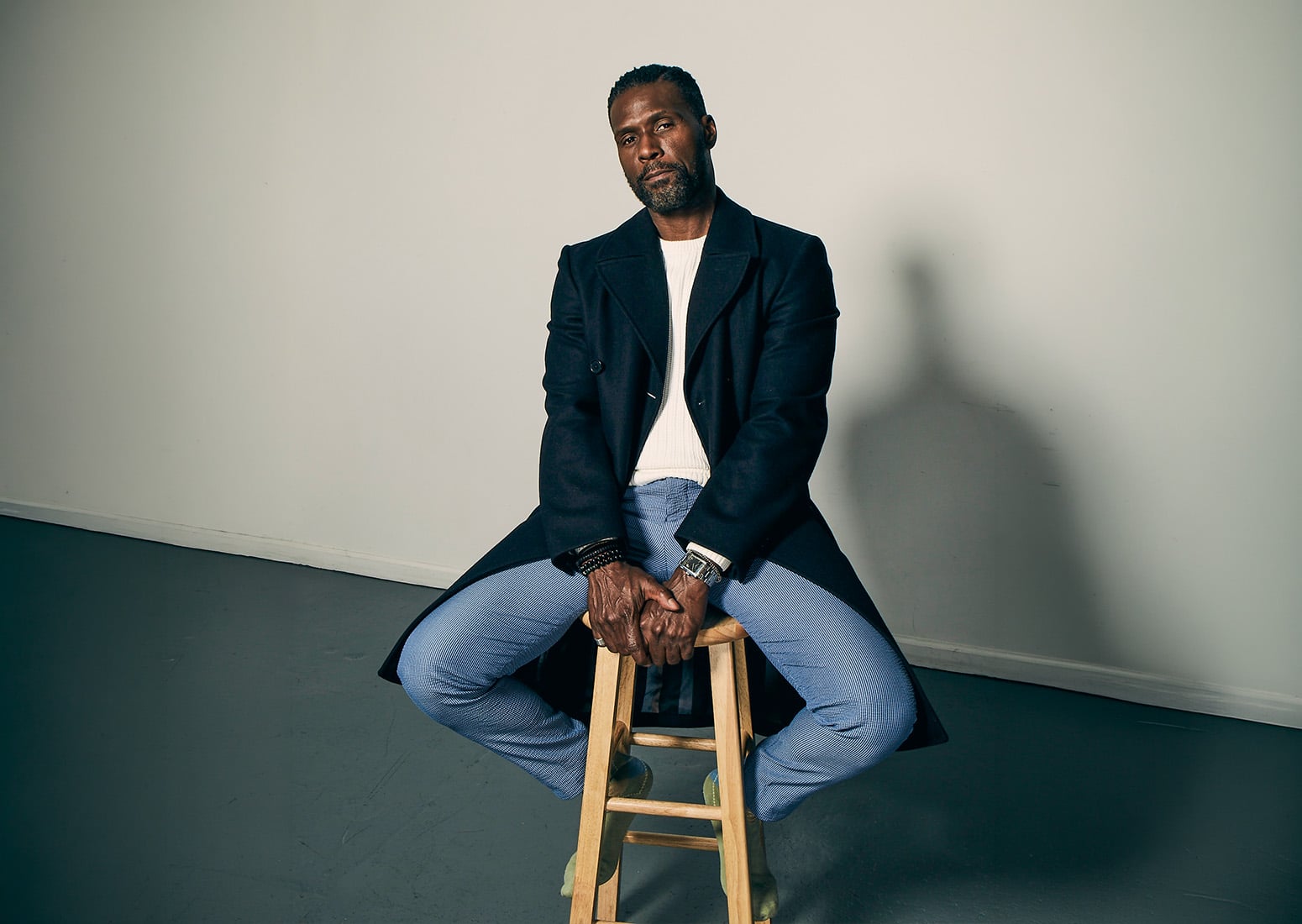
The veteran actor brings emotional gravity to Monarch: Legacy of Monsters and reflects on the life that has shaped his decades-long career.
Curtiss Cook does not carry himself like someone interested in stardom.
Even through a computer screen, there is a steadiness to him. No performance. No overly polished Hollywood sheen. Just presence — the kind that’s built slowly over decades of work, rejection, reinvention and survival.
It is exactly that quality that makes Cook’s arrival in season two of Monarch: Legacy of Monsters feel so compelling. On February 27, 2026, the highly anticipated second season expanded the Monsterverse on Apple TV+ into darker emotional territory, balancing a massive spectacle with questions surrounding fear, morality and human survival.
Cook feels naturally suited for that world because his performances have always carried emotional consequence beneath the surface.
Most audiences recognize him as the magnetic and deeply unpredictable Douda in Showtime’s The Chi, though his body of work spans decades across theatre, film and television. From Broadway productions of The Lion King and Miss Saigon to films including Shutter Island, Arbitrage and West Side Story, Cook has consistently gravitated toward characters that feel layered rather than performative.
“I really love television. I really love ensemble work,” Cook says. “I have characters that I still feel like haven’t been presented yet.”
What becomes immediately clear while speaking with him is that acting was never initially tied to fame. It began much earlier and much smaller in Dayton, Ohio, where Cook grew up as the oldest of five children. He started performing in elementary school productions that eventually evolved into larger theatre opportunities throughout high school, though, at the time, he still did not fully believe acting could become a real profession.
“I thought maybe I’d join the Navy,” he admits with a laugh. “My goal was honestly just to make $30,000 a year and have a small house somewhere.”
“Life Continues To Inspire Me. You Place Benchmarks For Yourself Based On Where You Are At The Time, But Then You Realize There’s So Much More Beyond That.”
That trajectory changed after a mentor encouraged him to audition for London’s prestigious Mountview Academy of Theatre Arts. Cook would later become the first American awarded a full scholarship to the school, an experience that permanently altered the direction of his life.
“Life continues to inspire me,” he says. “You place benchmarks for yourself based on where you are at the time, but then you realize there’s so much more beyond that.”
There is a refreshing honesty in the way Cook speaks about ambition. Unlike many performers trained to package themselves neatly for public consumption, he openly acknowledges the emotional complexity of the industry. The closer he moved toward certain career goals, the more he realized success often looked very different up close than it did from a distance.
“The s*** is hard. This business is hard,” he says, candidly. “Sometimes you just need to sit down and focus on yourself.”
That perspective became even sharper with fatherhood. A parent of five, Cook describes becoming a father as one of the defining forces of his life. While pursuing work in New York, he often brought his children with him to auditions, balancing creative ambition with survival, responsibility and presence.
“The most important thing I could show my son was his dad following his dreams,” he says. “Not only[to]do as I say but do as I do as well.”
Despite decades in the entertainment industry, Cook still speaks about acting less like a business and more like a craft he continues to study. He references spirituality often throughout the conversation, describing faith and self-awareness as grounding forces that helped him navigate both success and uncertainty.
“If you are your unique self and who you are, nobody can recreate that,” he says.
That philosophy feels increasingly rare within an industry driven by algorithms, visibility and constant performance. Perhaps that is also why Cook remains so compelling to watch. He does not approach characters from the outside in. He inhabits them fully, allowing contradiction, vulnerability and weariness to coexist naturally onscreen.
Now entering the world of Monarch, Cook continues to prove something Hollywood often forgets: Sometimes the most powerful presence in the room is the one not fighting to be the loudest.