For 35 years, Moscone Marble has transformed natural stone into extraordinary spaces, building a family legacy defined by creativity, craftsmanship and an enduring partnership.
On March 6, 1991, Nina Moscone Marrese crossed an ice storm with a baby in a bassinet to sign the papers for a new company. The shop waiting on the other side was hardly glamorous.
Moscone Marble began in a small, extraordinarily dusty unit on North Finch Avenue in Toronto with three employees and only a handful of stone slabs. On days that they knew a client had an appointment and would be coming in, they would stop working, clean the marble slabs and have an early lunch at 10 a.m., so the space could be made presentable for their customer.
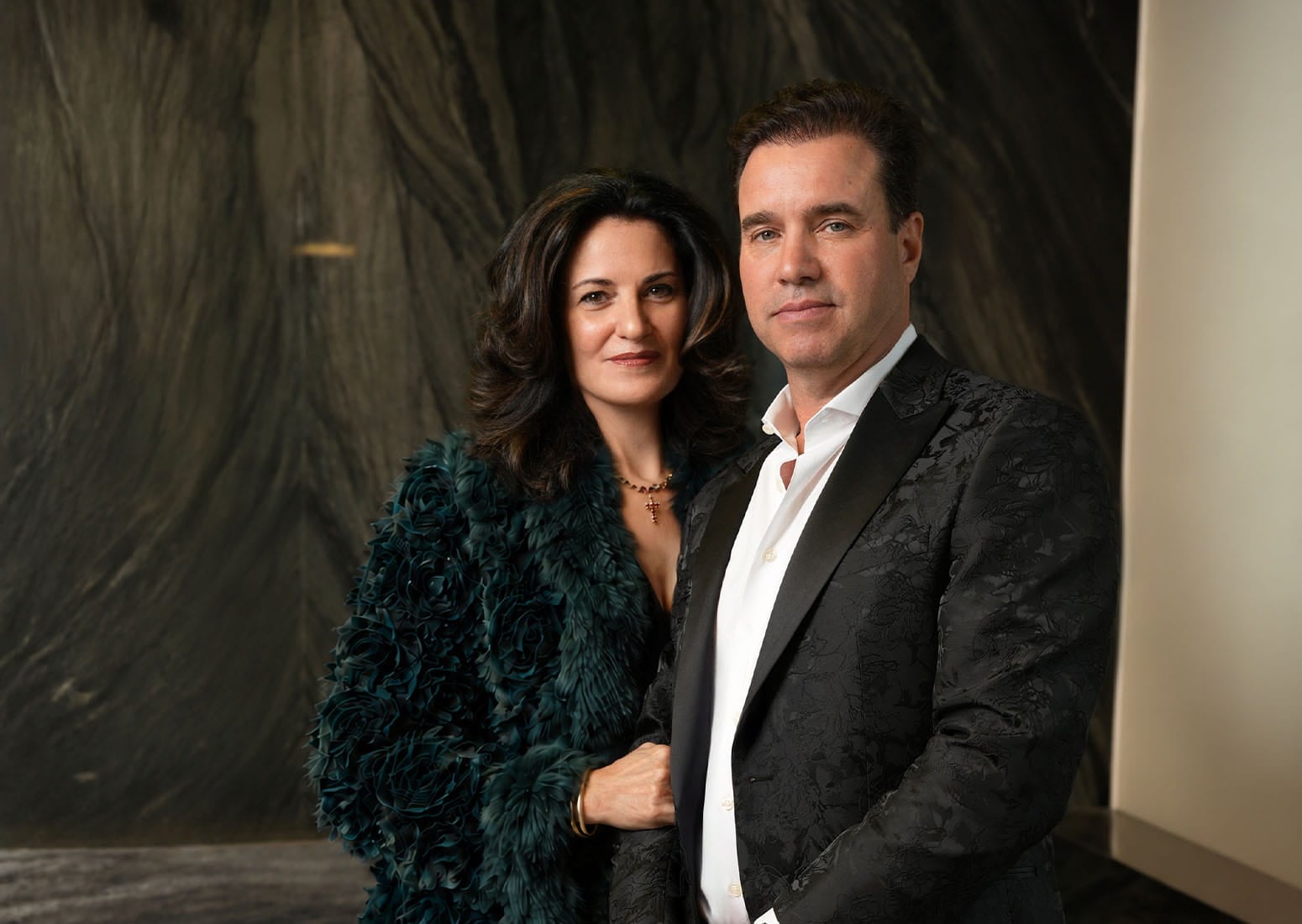
Thirty-five years later, nobody needs to stop the machines. Moscone Marble has grown from that modest Toronto shop into a sophisticated stone fabrication business trusted by some of the city’s most prominent builders. Yet, beneath the scale, state-of-the-art machinery and spectacular slabs, its original architecture remains remarkably intact: family, craftsmanship and the partnership between Anthony Marrese and Nina Moscone Marrese.
“We just work together as a team,” Anthony says. “We have a similar vision.” That partnership is less about doing everything together than knowing when to let the other person lead. Nina is the creative force, while Anthony has an instinct for the machinery, logistics and technical details required to turn ideas into something tangible.
Nina describes their dynamic as simply: “We each have our own role in the business, and that division of responsibility works because we trust one another.” It is a fitting philosophy for a business concerned with transforming something ancient into something entirely new.

Anthony and Nina met at 15 years old, long before marble became the backdrop to their marriage. In Moscone Marble’s early years, their youth occasionally worked against them. Anthony remembers builders asking to speak to the owner, refusing to believe that the twenty-something man standing in front of them was, in fact, the owner. “I grew a beard,” he recalls. The beard may have helped, but what ultimately built the company was considerably less cosmetic. “Hard work,” Anthony says. “Absolutely hard work.”
Today, the scale of the company tells the story. Moscone Marble has supplied stone for major projects and currently has both towers of Pemberton’s 33 Yorkville in its portfolio, encompassing approximately 1,150 units. Some client relationships have endured for more than 30 years.
Their explanation for that longevity is refreshingly uncomplicated: do excellent work, show up on time and, when something goes wrong, fix it. “We take accountability,” Anthony says. Longevity, however, has not made them conservative.
Anthony travels to Verona’s international stone fair to study new machinery, materials and techniques. “You never stop learning,” he says. “When you go there, you see new things.” Back in Toronto, Nina is often the one advocating for the unexpected. While selecting marble, she gravitates toward ideas that might initially seem a little daring for the local market.
“We Each Have Our Own Role in the Business, and That Division of Responsibility Works Because We Trust One Another.”
“Toronto’s very conservative,” she says. “I’m always pushing, saying, ‘Let’s try the green. Let’s try the red. Let’s try a different colour.’” That appetite for experimentation runs well beyond marble. Nina wrote and directed the film, Wisteria, with Anthony helping navigate the less cinematic realities of paperwork, grants and tax credits.
At home, life expands again: the couple has an agricultural business, roughly 250 cattle, horses with a habit of escaping and a farm they jokingly compare to Yellowstone. Perhaps that is why Moscone Marble feels less like a company built around stone and more like a company with a family story told through it.
Their children are now increasingly taking the reins of the business, while Anthony and Nina remain close enough to lend decades of experience when a project becomes particularly intricate. It is succession without disappearance, another evolution in a company that has spent 35 years figuring out how to preserve what matters while making room for what comes next.
Asked to describe Anthony as a slab of marble, Nina chooses the classics: Bianco Carrara and Statuario, marbles that are both from the same mountains associated with Michelangelo. “You’re the classic, babes,” she tells him. It is funny, affectionate and unexpectedly revealing. After 35 years of business and a relationship that began at 15, Nina still considers herself lucky. “This life is day-to-day, and you need that support,” she says.
For Anthony and Nina, la dolce vita ultimately comes back to some things simpler than marble, movies or milestones: autonomy, travel, Sunday gatherings and family.
Work and life have never been perfectly separated because, for the Marreses, they were never really meant to be. Thirty-five years after that ice storm, that walk with a bassinet and the start in a dusty little shop, they are still building together. Some things, it seems, really are set in stone.