The greatest show on Earth once again delivered the beautiful game as nothing else ever can — or ever will.
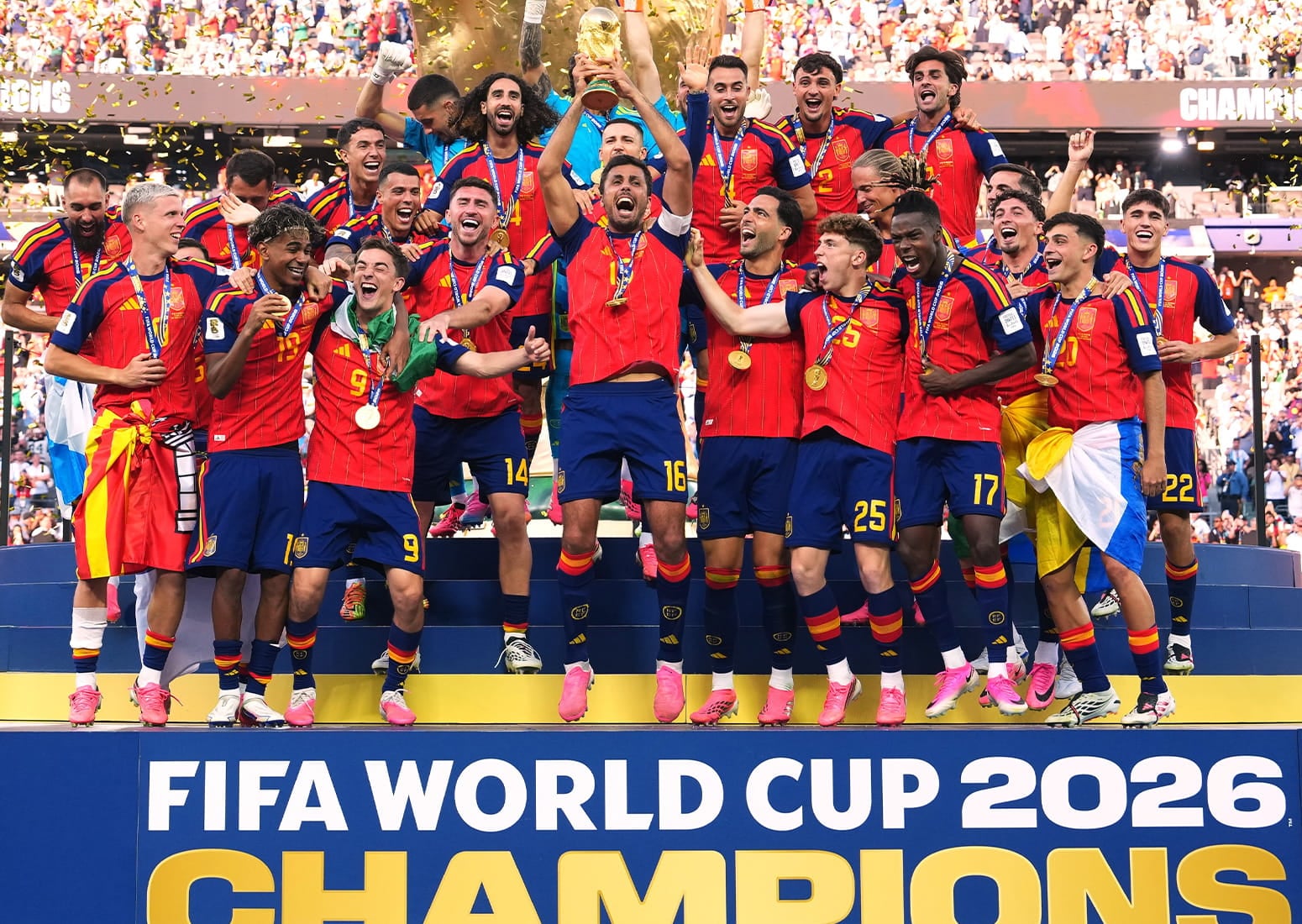
Ferran Torres’ goal in the 106th minute of the game in extra time gave Spain a 1-0 win over Argentina to claim the FIFA World Cup 2026 title, its first since winning it all in 2010. Spain’s technically proficient possession game was smothering in shutting down Argentina, at one point having a 20-0 dominance in attempts on goal. The young Spaniards were suffocating in winning its 38th straight international match, a new record. As Argentina discovered, you can’t score if you don’t have the ball. Truth be told, the beautiful game had an ugly final — a one- sided, chippy, physical affair with more diving than Olympic swimming, but Spain was the deserving champion.
The announcement in June 2018 that Canada, Mexico and the United States would co-host in 2026 — and that the tournament would be expanded from 32 nations to 48 — was not without controversy. Specifically, would more nations result in diluted play? The ultimate answer was ‘no’, as some of the play was truly spectacular, leading FIFA to now consider 64 teams in 2030.
However, controversy seemed to increase only as the tournament began in mid-June. Geopolitical instability had only increased, the three co-hosts were bickering over trade, one of the co-hosts was actually at war with one of the participating nations, and there were visa issues with teams and fans seeking to enter the U.S. But finally, the focus was on football.
Game on.
For the Canadian men, this was a World Cup of firsts: first time hosting, first World Cup goal scored on home soil (Cyle Larin in an opening 1-1 draw with Bosnia and Herzegovina), first World Cup win, (a 6-0 dismantling of Qatar in Vancouver) and first time advancing from the group stage into the knockout round, finishing second to Switzerland. As a record-setting heat wave spread across the country, so did Canada’s pride for the National Men’s Team. Raucous stadiums greeted the team, watch parties attracted thousands, pubs and restaurants were jammed, and, for a couple of weeks, you could say a hockey nation turned into a nation of soccer fanatics. The impact on younger generations may be massive and lasting.
A 1-0 extra time win over South Africa in Los Angeles on June 28, on Stephen Eustaquio’s bullet, sent the country over the top with passion. Ultimately, they were eliminated by Morocco in the Round of 16 in Houston but had clearly outplayed the world’s 6th ranked nation for the majority of the first half. Expectations have been raised as Canada’s men’s national team, ranked 112 th in the world in 2014, now has a seat at the adults’ table of world football.
The expansion to 48 teams also brought new faces to the dance, and, as always, it was the fans who made the tournament the biggest stage in the world, such as Portugal and Croatia fan marches through downtown Toronto. The Caribbean island nation Curaçao became the smallest country, both in population (158,000) and size (422 square kilometres), to ever participate, and their dancing joy was infectious (12 Curaçaos can fit inside Canada’s smallest province, PEI).
The tiny group of 10 islands off the coast of West Africa, Cabo Verde, ranked 64th in the world, took defending champion Argentina to extra time before falling 3-2, only surpassed by Argentina scoring three in the final 13 minutes to defeat Egypt 3-2, a stunning comeback that had Lionel Messi in tears. Once again, it was little human moments that made up a World Cup. Scotland defeated Haiti 1-0 for its first World Cup win since 1990 and, with a few days to kill in Boston between games, The Tartan Army of Scottish fans basically drank the city dry, according to several pub owners. As the saying goes: “No Scotland – No Party.” The world was also amazed by the intricately timed and choreographed cheering and machinations (YouTube, “Viking Rowing”) by the fans of Norway, where, clearly, they must have an absurd amount of free time.
The game’s greatest players don’t simply arrive – they are summoned by the moment. Argentina’s maestro Messi, France’s irrepressible Mbappe and Norway’s striking Viking Haaland all engaged in a 24-carat race for The Golden Boot as the tournament’s top scorer, ultimately won by Kylian Mbappe, who now has a record 22 goals in just three World Cups. The tournament also introduced us to Spain’s remarkable 19-year-old Lamine Yamal, becoming the youngest to score since some 17-year-old kid named Pele did in 1958 — nice company to keep. It was perhaps fitting that a World Cup, which featured so much of The Beatles catalogue in its marketing, would feature football’s “Fab Four” in its semi-finals: France vs. Spain and England vs. Argentina. It was Sacre Bleu for the French on Bastille Day as Spain dominated in a 2-0 win to deny France its third straight trip to a final. England was, well, “so English” in its come-from- ahead 2-1 defeat by Argentina. England’s strategy to park the bus, play defense and allow Messi to work his magic raised many eyebrows (if not screams) among infuriated English supporters. Perhaps sensing the anger, England rebounded to finish 3rd overall for its best showing since winning it all in 1966, in a wild 6-4 win over France — a game of two distinctly different half- periods.
Once again, the World Cup transcended sports and became a global cultural extravaganza. Five weeks of national pride and passion, tears in victory and defeat, with smiling, dancing, joy and celebrations amongst global strangers.
Despite political contretemps (we’ll leave it at that) and tackled players engaged in perhaps the worst overacting since Love Story (and that’s saying something), what will FIFA World Cup 2026 leave us with? Hopefully, a legacy to last a lifetime of how football can truly unite the world. Oh, and that Spain is really, really good.
@fifaworldcup